
Watson-Marlow Pumps Group Peristaltic Pumps

Watson-Marlow has, through selective acquisition, innovative product development and geographical expansion, grown rapidly to lead the world market for peristaltic pumps, tube and Bredel hose pumps. This is an expanding segment of the positive displacement pump market, and the peristaltic principle enables contaminated, abrasive or corrosive fluids to be pumped safely, reliably and accurately.
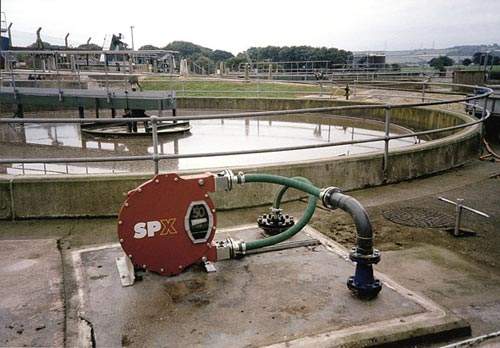
Primary / thickened sludge feed
The simple glandless, "straight through" construction has clear advantages in handling viscous sludges liable to contain grit, rag type or other solids which cause blockages. Whilst the ability to impart minimal shear, combined with the high levels of volumetric accuracy when handling additives such as polyelectrolyte, is important in terms of both efficient flocculation and additive consumption.
Reduced operating costs can be achieved by the installation of Watson-Marlow pumps in the feed of primary or thickened sludge to digesters or filter presses, and in primary tank auto-desludging. To complete primary auto-desludging, following digester treatment, the sludge goes to secondary storage tanks, where polyelectrolytes are dosed by low-pressure peristaltic pumps prior to dewatering.
Peristaltic pumps
Peristaltic pumps have no valves, seals or glands, and the fluid contacts only the bore of the hose or tube. Simple to install, easy to use and quick to maintain, provide a low whole life cost, they are the hot new technology, and the world’s fastest-growing pump type.
Supply of quality potable water within current permit levels is paramount, and efficient plant operation is essential in meeting these critical standards. Metering applications, typically with sodium hypochlorite, lime or ferric chloride, often place arduous demands on pumps. These chemicals can cause vapour locking, abrasive wear and pump clogging, leading to poor performance and premature failure of traditional metering pumps. Watson-Marlow peristaltic pumps are a proven solution and exceed performance expectations.
- Self-priming to 30ft and dry-running
- 875,000:1 turndown – same pump!
- Accuracy to ±0.5%
- Lowest Life Cycle Cost (LCC)
- Sealless design
- Microlitres to 33L/min
- Reversible
- Will not vapour lock
Applications include pH control, disinfection, primary and secondary disinfection, accurate sampling, metering and dosing of difficult fluids such as sodium hypochlorite, ferric chloride, sodium bisulphite, alum, fluoride, carbon and lime slurries, polymers, aqueous ammonia, potassium permanganate, caustic, aluminium sulphate, flocculants and lime slurry.
High-pressure hose pumps
High-pressure hose pumps offer increased reliability and cost reductions for sludge applications. Critical processes such as centrifuge feed must be carried out reliably. Hose pumps are able to meet these demanding performance requirements.
- Abrasion – grit resistant hose
- 100% efficient – no slip
- 80m³/hr (0gpm to 350gpm to 16bar / 232psi)
- Lowest Life Cycle Cost (LCC)
- Only one wearing part – the hose
- Reversible
- Dry-running
- Self priming to 30ft suction
Hose pumps offer efficient handling of primary, secondary, digested thickened sludge, RAS, WAS and scum, and are used in DAF, septage, sampling, grit removal, belt filter presses and centrifuge feeds.
Please use the contact details below to make an enquiry about our products.
See also:
Mining Technology- Watson-Marlow – Peristaltic and High-Pressure Hose Pumps
Watson-Marlow Pumps Group Images

Products and Services
Video
White Papers
Press Release
Following the highly successful launch of the revolutionary Qdos 30 peristaltic metering pump, Watson-Marlow Pumps Group is now introducing the larger Qdos 60 model.
Read moreA Bredel APEX15 hose pump from Watson-Marlow Pumps Group has been installed at Thames Water's Mogden sewage treatment works (STW). Thanks to the APEX15, final effluent samples can now be collected automatically before transfer to the lab for testing.
Read moreUntil recently, turbidity testing at the Pontsticill Water Treatment Works in the Brecon Beacons National Park relied on the use of bellows pump technology.
Read moreThe revolutionary new Qdos 30 metering pump from Watson-Marlow Pumps Group is proving a resounding success in Barrie, Canada.
Read moreSince adopting Bredel SPX50 hose pumps from Watson-Marlow Pumps Group in various parts of its process, the water treatment plant at Kembla Grange has saved significant costs.
Read moreIn what’s described as a ‘no-valve metering revolution’ Watson-Marlow Pumps Group launches its revolutionary Qdos 30 pump range. Developed in response to extensive industrial customer feedback for improved chemical metering, the Qdos 30 eliminates ancillary equipment, enhances productivity and reduces chemical waste through more accurate, linear and repeatable metering than typical solenoid or stepper driven diaphragm metering pumps.
Read moreDecades of experience and knowledge have combined with closely scrutinised customer feedback to deliver APEX, three new hose pumps from Bredel, part of the Watson-Marlow Pumps Group.
Read moreA specialist manufacturer of water quality measurement and monitoring systems is using peristaltic pump technology from Watson-Marlow Pumps Group for use in chlorine monitoring equipment after similar pumps were found to be less reliable.
Read moreEngineering, consulting and construction company Black & Veatch has installed a number of 520 series and 620 series peristaltic models from Watson-Marlow Pumps Group, at Thames Water's Advanced Water Treatment Works (AWTW) in Walton, Surrey
Read moreIn response to increased demand for higher flow rates and faster delivery times, Bredel Hose Pumps has re-engineered its high capacity SPX280 and SPX2100 peristaltic pumps. The result of this product update for users is improved durability and further reduced maintenance downtime. Addi
Read moreWhen Prelok encountered problems using both impeller and diaphragm pumps to circulate adhesive coating fluids at its Willenhall plant in the West Midlands, this specialist in the application of pre-applied locking and sealing processes for threaded components turned to 521 Series pumps from Watso
Read moreHaving suffered repeated failures using conventional impeller pumps for the transfer of liquid egg in glazing processes operated at Cornish food manufacturer Rowe's the bakers, the company turned to peristaltic pump technology from Watson-Marlow Pumps Group. Originated in 1949 as a bake
Read moreLeading pump company Watson-Marlow Pumps Group will showcase its enhanced range of positive displacement pump technologies at stand 5673 at the 2010 TOTAL Exhibition. Following the recent acquisitions of aseptic filling and capping systems specialist Flexicon and sinusoidal pump com
Read moreWatson-Marlow Pumps has launched three IP66-rated cased peristaltic pumps with certified Profibus DP networking capabilities, namely the 520Bp, 620Bp and 720Bp. In the past it has been necessary to use a Profibus gateway to control cased peristaltic pumps using this protocol, but never
Read moreWorld-leading positive displacement pump manufacturer, Watson-Marlow, has acquired the German MASO / sine pump manufacturing business from MASO Process-Pumpen and Sundyne Corporation. The purchase demonstrates the Watson-Marlow Pumps Group's continuing commitment to leadership and innov
Read moreWatson-Marlow Pumps Group has opened two new offices, in Zurich and Mexico City. The group can now offer Swiss customers direct shipment from its UK plant in Falmouth, saving 20% on transport costs and seven days of delivery time. Swiss orders ship on next-day-delivery terms.
Read more
Peristaltic pump specialist Watson-Marlow Pumps Group is reporting significant growth in the South African water industry, as demand increases for the precise dosing capabilities of its peristaltic technology. The peristaltic pump market's growth in South Africa is heartening news. Desp
Read moreIt's the story that has become a national curiosity: male fish swimming in our rivers have begun spontaneously developing female characteristics. Research dating back more than 15 years has revealed the underlying cause of this phenomenon lies in our improved water quality, allowing fish to colon
Read moreDesalination – the treatment to turn seawater into tap water – is rapidly gaining ground in the UK. Nicola Martin discovers the crucial role that peristaltic technology is playing in this type of water treatment. Following trials and small-scale plants in the drought-ridden south-east o
Read moreAshley Shepherd, UK sales manager at pumping specialist, Watson-Marlow Bredel, talks about the importance of accurate effluent treatment for the food manufacturing sector in the context of the Water Framework Directive. The process of wastewater treatment is set to change forever with t
Read moreThe viscous lime slurry used to maintain a neutral pH during the water treatment process was causing frequent blockages in the diaphragm pumps used by Buckton Castle WTW. However, the installation of two peristaltic hose pumps supplied by Watson-Marlow Bredel has overcome this problem, substantia
Read moreSeparating suspended solids from liquids before discharging to sewer or water course is a headache that construction companies have had to endure for a considerable period of time. Aggravating the problem further is when materials won’t settle quickly. To overcome this obstacle Monmouth-based Si
Read morePeristaltic Pump Technology Replaces Timer Controlled Valves at Lavister Waste Water Treatment Works and Improves Primary Sludge Consistency Two Watson-Marlow Bredel SPX50 hose pumps have been installed at Dwr Cymru -Welsh Water’s Lavister Waste Water Treatment Works in North Wales, sig
Read moreProcess engineers at a Severn water treatment works (WTW) are benefiting from accurate chemical dosing, reduced maintenance and reliable operation thanks to the replacement of rotor and stator pumps with peristaltic technology. The peristaltic pumps, supplied by specialists, Watson-Marlow Bredel
Read moreFour Watson-Marlow Bredel 520 series dosing pumps have been installed at United Utilities Haslingden Grane Water Treatment Works in Rossendale, Lancashire. The new pumps will replace earlier 500 series pumps which have delivered trouble-free service since commissioning in 1993. The new
Read morePeristaltic pumps supplied by Watson-Marlow Bredel are delivering trouble-free, 24-hour operation of lime slurry metering at the Blackmoorfoot WTW near Huddersfield. Serving over 400,000 people, the WTW at Blackmoorfoot was the first full-size three-stage water treatment works to be bui
Read moreWatson-Marlow Bredel, the leading manufacturer of peristaltic pumps, offers the heavy-duty SPX pump for challenging environmental applications. The SPX reliably handles a variety of harsh materials, including abrasive sludge. Advanced hose technology enables the SPX to pump grit-fille
Read moreIncreasing its overall performance and pressure capabilities, leading peristaltic pump manufacturer Watson-Marlow Bredel has launched the 520 LoadSureâ elements range. The combination of the tube element and pumphead design provides pressure performance up to 7 bar, offering the company new appl
Read moreSouth West Water is using a peristaltic pump from Watson-Marlow Bredel for dosing coagulant into raw reservoir water for purification purposes. It is thought to be the first time peristaltic technology has been used on a coagulant application, certainly within the southwest region. Ori
Read moreWhole life costs are playing an ever-more important role in pump selection by the water and wastewater industry. Interestingly, energy use is no longer the benchmark for making efficiency and cost comparisons, according to Philip Bolton, water industry specialist at Watson-Marlow Bredel.
Read moreNow that the dust of the AMP 4 round has settled, the UK’s water and sewerage companies are underway with their plans to maintain, upgrade and develop their asset base over the next five years. It is probably true to say that uncertainty and risk have played a greater role than in any of the pr
Read moreWith the UK water and wastewater industry under continual pressure to contain maintenance and running costs, one of the easiest routes plant and operational managers often look to make savings is the readily identifiable area of replacement parts and spares. Many companies in the indus
Read moreLeading the way with new sewage treatment methods, Thames Water South East Provinces Waste Water site in Cranleigh is using ferric chloride as a flocculating agent in order to meet the AMP 3 biochemical oxygen demand parameter. For a totally reliable pump that could deal with this highly corr
Read moreContaminant free water Reliability under all operational conditions and the ability to deliver a consistent, volumetrically accurate sample over long periods were the key factors in the selection by Severn Trent Services of Watson-Marlow Bredel peristaltic pumps for fitting into thei
Read moreWatson-Marlow Bredel Pumps has designed a bespoke pump system for J N Bentley Ltd of Skipton, North Yorkshire. The system consists of self-contained desludging units complete with diesel generators for sites operated by Yorkshire Water. J N Bentley is the contracting part of joint v
Read moreRegional Offices
Cornwall
Falmouth
TR11 4RU
Other
United Kingdom
Watson-Marlow Bredel S.A. (Pty) Ltd
PO Box 2742,
2040 Gauteng,
Honeydew,
Other
South Africa
Watson-Marlow Bredel Pumps Inc
37 Upton Technology Park,
Massachusetts
Wilmington,
01887-1061
Other
United States of America
Spirax-Sarco Engineering
107 Gui Qing Road,
Shanghai 200233,
Caohejing Hi Tech Park,
Other
China
Other
Other